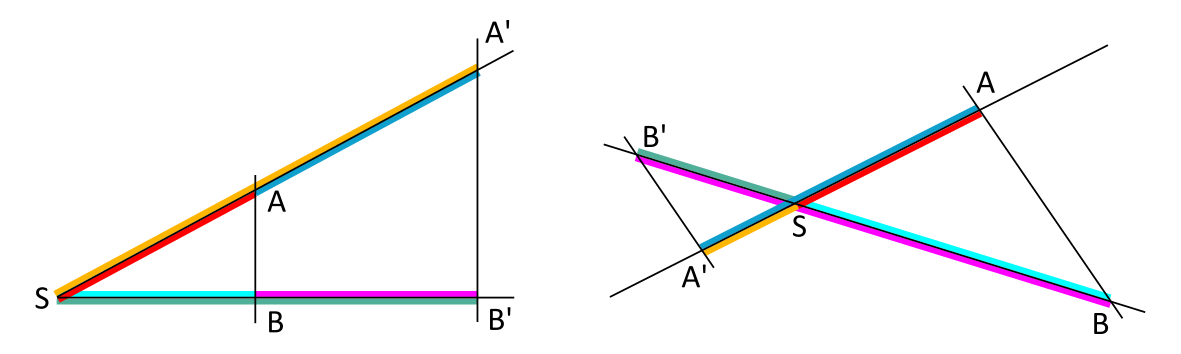
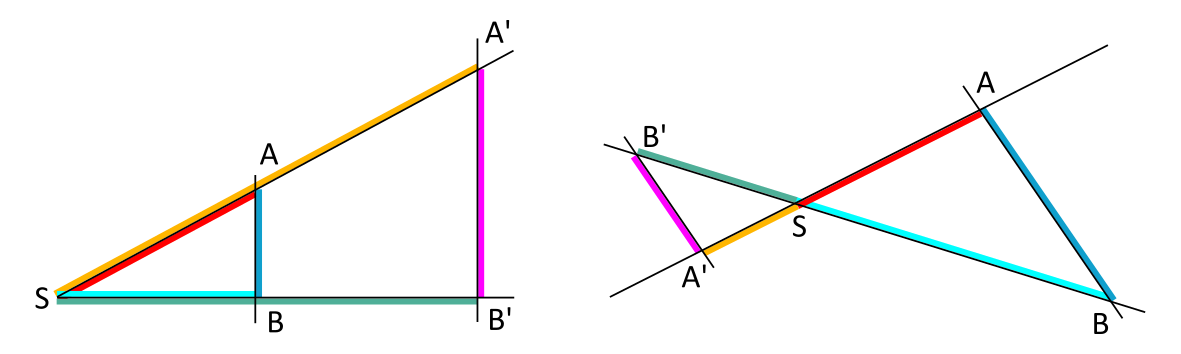
The two intercept theorems help us express relationships between lengths of two or more rays that intersect at a point and are all intersected by two parallel lines.
Classic examples include triangular distributed loads in technical mechanics, which need to be cut in arbitrary sections for determining shear forces, or conical or pyramidal bodies,
whose diameters often need to be determined as a function of the coordinate \(x\) in strength of materials.
On this Page
First Intercept Theorem
If two rays with a common vertex \(S\) are intersected by parallel lines that do not pass through the vertex \(S\), then the corresponding segments on one ray are proportional to
the corresponding segments on the other ray.
If two rays with a common vertex \(S\) are intersected by parallel lines that do not pass through the vertex \(S\), then the segments on the parallel lines are proportional to the
corresponding segments on the rays.